
Bahuang Jiushi · Culture & everyday life
What Does 18K Gold Mean? Fineness, 750 and Weight
· Bahuang Jiushi · English
Translate 18K and 750 into the same proportion, then use three fictional cards to distinguish alloy weight from complete-item weight. Apply the reading method to the current Top Fortune Stick listing without treating it as a test.
An “18K gold” description tells you about the fineness of a gold alloy. It does not mean the piece weighs 18 grams. When choosing jewellery, read the proportion, the weight and the component being described separately. That lets you decide whether two labels mean the same thing and whether the available figures support a calculation.
Read 18K, 750 and grams as different kinds of information
The World Gold Council explains that 18K gold contains 75% gold and 25% other metals, and that 750 is the corresponding fineness expressed in parts per thousand. Put the two forms on the same scale:
- 18 ÷ 24 = 0.75 = 75%.
- 750 ÷ 1000 = 0.75 = 75%.
“18K” and “750” can therefore express the same gold proportion. The larger number 750 does not mean more grams of gold. A figure followed by “g” describes weight; the 18K label alone supplies no weight.
This explains a material description. Understanding a label does not establish that a particular physical item meets it. No item was weighed, tested or checked against a certificate for this article.
Keep the product description separate from its image
When checked on 3 November 2026, the Top Fortune Stick Necklace product page listed “18K Gold”; the corresponding Chinese material field read “18K金”. Record that listing statement accurately, then use the proportion above to understand it. Do not infer fineness from brightness in a photograph.
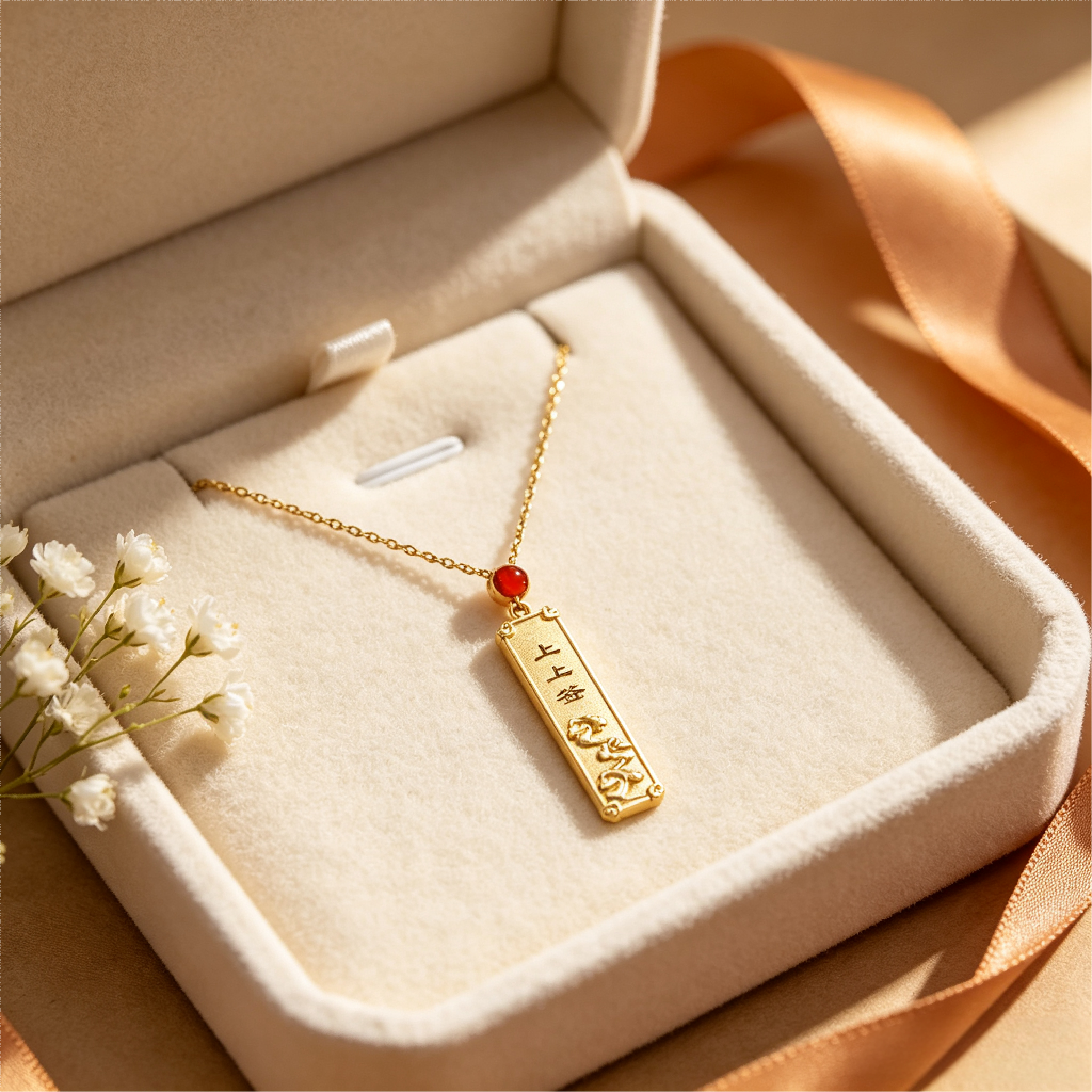
Official Top Fortune Stick Necklace product image: the chain, narrow pendant and red accent identify the item being discussed; the image does not test gold content. The box, flowers and background do not establish what is included in an order.
“18K” is not a colour name, and a gold-coloured appearance is not a fineness test. An image can help you decide whether you like a design, while the material field records the seller's description. Neither replaces the other. Explaining the common 750 notation here does not mean that a 750 mark has been observed or confirmed on this particular item.
The checked product page did not supply a gold-alloy weight suitable for the exercise below. This article therefore assigns no grams-of-gold figure to the necklace and does not estimate weight from the apparent thickness of its chain or the size of its pendant in the image.
Work through three fictional material cards
These cards and figures are original exercises, not Bahuang Jiushi product specifications, test records or sales quotations. For the calculation, assume the stated proportions are accurate and that each weight covers exactly what its card says.
- Card A: “18K gold; the separately established gold-alloy portion weighs 3.20 g.” The calculated gold mass is 3.20 × 75% = 2.40 g. Under these assumptions, the other alloy metals together account for 0.80 g.
- Card B: “750; the separately established gold-alloy portion weighs 3.20 g.” Dividing 750 by 1000 also gives 75%, so the result is the same 2.40 g. Changing the notation has not changed the proportion or weight in this exercise.
- Card C: “18K gold jewellery with a stone; complete item weight 3.20 g; gold-alloy weight not stated.” Do not multiply the complete 3.20 g by 75%. Other components have not been separated from that weight, so the required gold-alloy weight is missing. The result is “not calculable from the information provided”.
The decision is the same across all three cards: calculate when the relevant scope is known; stop at the missing information when it is not. Do not borrow Card A's assumptions to fill Card C's gap, or treat the complete weight on Card C as a pure-gold weight.
The matching answers for A and B establish only the same proportion and calculated gold mass within the exercise. They do not show that two real pieces have the same construction, dimensions, wearing experience or price, and they are not evidence of the content of any physical item.
Keep a useful reading note before choosing
For another product card, copy the material wording, express the fineness as a proportion, and record any weight separately with its unit and scope. A completed note might say: “The page says 18K; this describes a 75% gold alloy; no weight is listed; I can interpret the fineness but cannot calculate grams of gold.” That is already a useful conclusion. Every field does not need to become a question to the seller.
Seek further information when a missing detail actually affects your choice. If you need to distinguish the weight of a complete necklace from that of a particular gold-alloy component, specify those scopes rather than asking only “How much gold is there?” If documentation is needed to support a material assessment, check which item it refers to and what it establishes. A number by itself does not complete that check.
Once the material wording is clear, use the two-necklace comparison guide for design preferences and wearing conditions. Keep currency, delivery and other arrangements in the separate pre-purchase checklist. For current item information that remains missing, use Bahuang Jiushi's public contact page with the exact product link and the specific detail you need.
Source
The World Gold Council's explanation of gold jewellery colour, caratage and purity covers 18K gold content and the 750 notation. The three material cards and calculations above are original exercises. References to the product listing reflect the stated check date; consult the current product information when making a choice.